
Guide · Interior Detailing
Removing Sand, Salt and Pluff Mud from Carpets
By Trent Sloan, Illustrious Mobile Detailing · Written from how we actually do the work in Charleston, SC.
Sand, salt and pluff mud leave car carpets the same way they arrived - with water. Vacuuming skims the surface, but sand sinks to the carpet backing, salt dissolves into the fibers and holds moisture there, and pluff mud dries into a fine silt that works deep into the pile. The removal that works is hot-water extraction: shampoo loosens the load, and pressurized hot water flushes it out of the fibers entirely. The guide below explains what each of the Lowcountry’s three carpet enemies does, how the professional removal runs, and how to slow the invasion between details.
Key Takeaways
- Sand abrades, salt holds moisture, pluff mud silts deep
- All three end up below vacuum reach - extraction is the exit
- Waste water runs gritty long after carpet looks clean
- Rubber mats + weekly shake-outs slow the invasion
Meet the three enemies
Sand is crushed quartz: angular, heavy, abrasive. It sinks fast, hides in seat rails and carpet backing, and grinds fibers with every foot movement - a slow sandpaper built into your floor. Salt arrives with beach air and winter-free Lowcountry roads; dissolved into damp carpet it holds moisture against the floor pan and feeds the musty smell, and it recrystallizes in the pile as a white crust. Pluff mud - the Lowcountry’s marsh mud - is the subtle one: carried in on shoes and dog paws from boat landings and marsh edges, it dries to a gray silt that powders deep into carpet and carries the marsh’s sulfur smell with it.
Why extraction is the only full answer
All three enemies share one property: they end up below the surface, where airflow-based cleaning cannot reach. A vacuum’s suction drops off within the pile; the backing layer keeps its load. Extraction reverses the flow - solution is pushed into the pile and pulled back out, carrying the suspended sand, salt and silt with it. Passes repeat until the return water runs clear, which on a James Island beach car or a Johns Island landing truck can take a while: the waste water tells the story, running gritty and gray long after the carpet looks clean on top.
The professional sequence for Lowcountry carpets
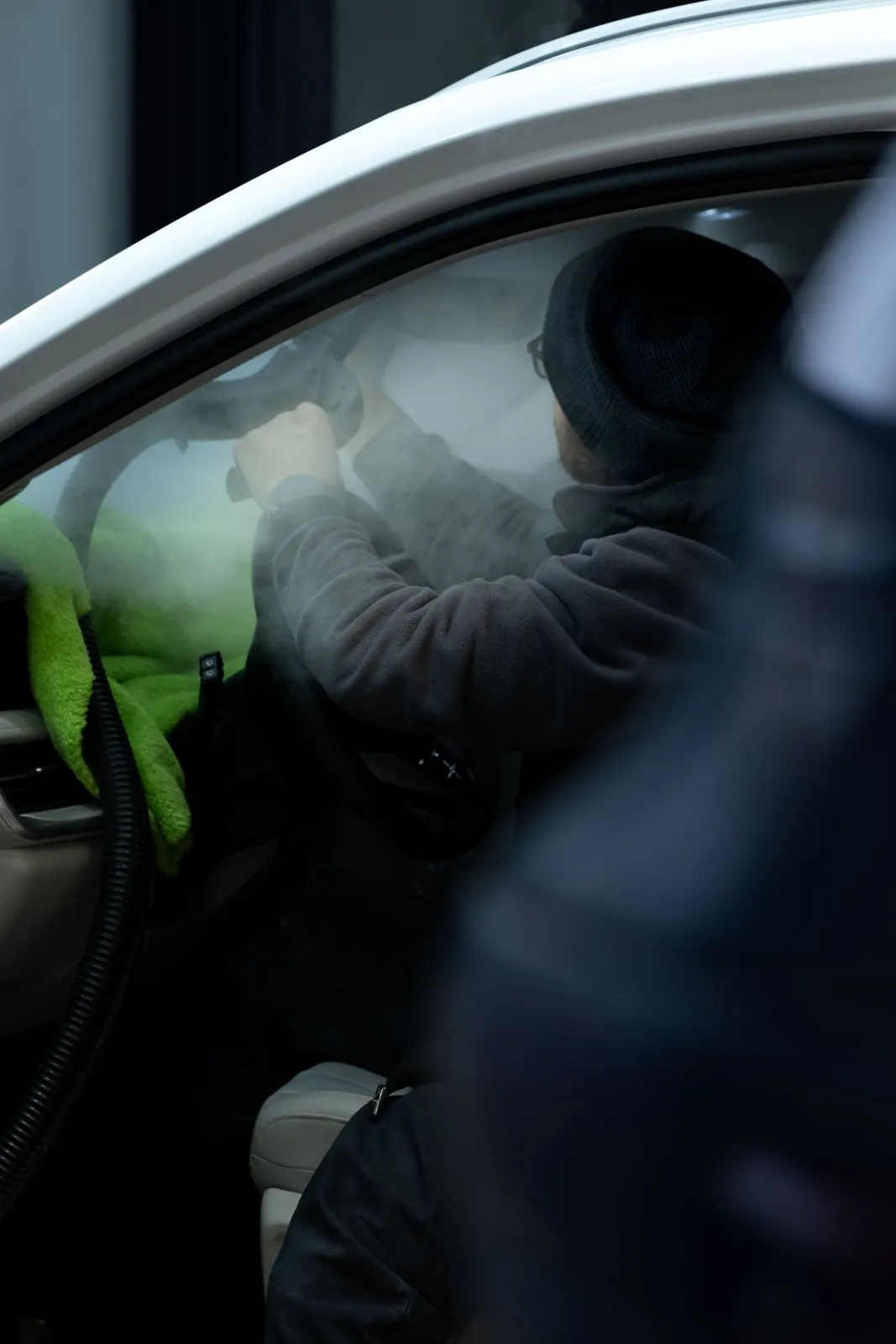
Dry work first: mats out and beaten, a meticulous vacuum with crevice tools along rails, seams and the spare-tire well, plus compressed air to blow grit out of seams and pedal areas. Then pre-treatment of the stained and salted zones, shampoo worked into the pile, and hot-water extraction in overlapping passes. Salt-heavy areas may get a dedicated rinse pass, because dissolved salt needs dilution, not just soap. Steam finishes the edges and vents. Our Standard Interior Detail includes this entire sequence - it was, frankly, designed around Charleston carpets.
Slowing the invasion at home
Mats are your sacrificial layer: heavy rubber mats in beach and landing season catch most of the load and hose off in the driveway. Shake mats weekly - sand left in a mat still migrates. Keep a door-pocket brush for shoes and paws at the beach lot and the landing. Rinse the dog before the ride when you can; wet sandy paws are the fastest carpet-loaders in the Lowcountry. And if carpet gets soaked - a spill, a leak, a flooded street - dry it actively with airflow the same day; damp carpet plus salt plus Charleston humidity is the mildew recipe.
This guide is part of our interior detailing series. If your car is due, we bring this exact process to your driveway anywhere in our service areas - including Johns Island - with published package prices and a walk-around before we leave.
One last Charleston note: interiors in Johns Island rarely fail all at once - they decline a beach trip, a school run and a humid week at a time, until one day the cabin simply feels old. An interior detail on rhythm interrupts that slide while it is still cheap and gentle to reverse. If this guide described your seats, your carpets or your vents, the reset is a single visit: we bring the extraction and steam to your driveway, and the car smells like a car again by the time we leave.
Keep Reading
Related guides & the service
FAQs
Questions This Guide Answers
Why is there still grit after I vacuum really well?
Because the load sits at the carpet backing, below where suction works. It is not your technique - it is physics. Extraction flushes from within the pile, which is why it succeeds where vacuuming cannot.
Can salt in the carpet really cause damage?
Yes - salt holds moisture against the floor pan and accelerates corrosion, and it feeds the musty smell cycle. Removing it is protective maintenance, not just cosmetics.
How often do Lowcountry carpets need extraction?
Beach and landing households: twice a year minimum. General drivers: every 4–6 months with your interior detail keeps the deep load from ever building.
Ready when you are
Tell us the car and where it will be - we’ll confirm your slot and bring everything with us, water and power included.